I was listening to a Radio24 program1 and the topic immediately struck me. The episode is titled “La scomunica digitale”2 (Italian for Digital Excommunication). In that episode, the radio host introduced the case of Nicolas Guillou3, a French ICC judge sanctioned by the Trump administration. This sanction is a ban from US territory, but it also prohibits any American individual or legal entity (including their subsidiaries everywhere in the world) from providing services to him.
The radio host, together with his guest Paolo Benanti4, drew a clever comparison between the excommunication of Spinoza (1656) and what is happening to Guillou right now. In fact, a ban from receiving services provided by American companies acts much like an excommunication in today’s world.
The excommunication of Spinoza
Spinoza was a Dutch philosopher who was excommunicated by the Portuguese-Jewish community leaders in 1656. The reason for the excommunication was his views on the nature of God and the universe, which were seen as heretical at the time. The excommunication he received was of the most stringent level: a herem5.
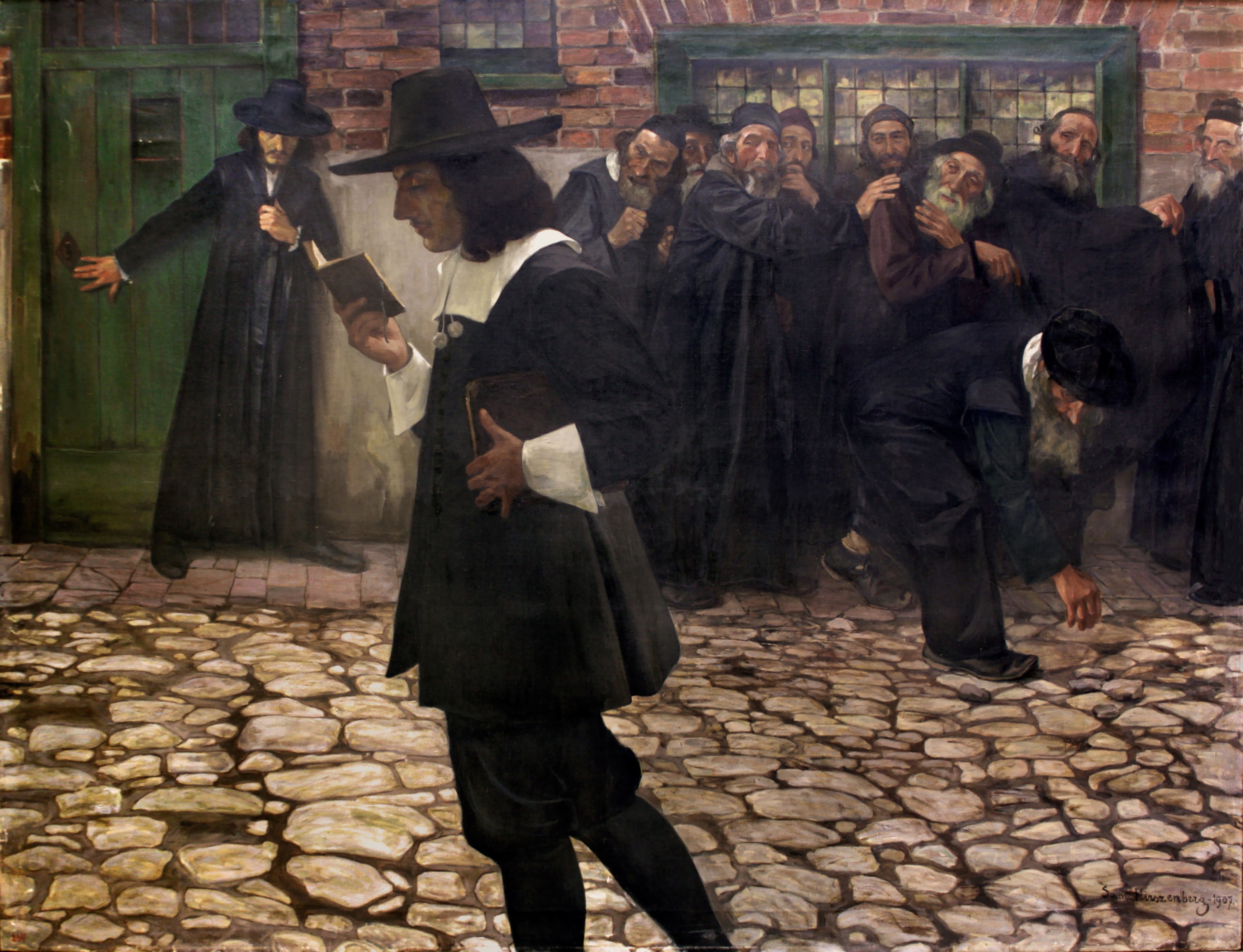
A herem has an indefinite duration and entails total social and religious ostracism. Any member of the Jewish community is strictly forbidden from having any kind of interaction with the excommunicated person. This, of course, also means that any business interaction with the excommunicated person is forbidden.
The US sanction
The US Department of State sanctioned Guillou in 2025 because of his role in the pre-trial panel that approved arrest warrants for the Israeli Prime Minister Binyamin Netanyahu.7 The Office of Foreign Assets Control (OFAC) of the Department of the Treasury can financially enforce the sanction, resulting in the economic banishment of the person. Every US company is required to:
- Asset Freeze: Freeze any assets held by the person in the US or by any US company. This includes bank accounts, property, company shares, stocks, bonds, and any other financial assets.
- Service Ban: All US persons and companies (and their subsidiaries) are forbidden from providing any service to the person. This includes tech giants like Alphabet, Meta, Amazon, and Microsoft, as well as payment networks like Mastercard and Visa.
The similarity
The similarity between the two cases is that both are a form of ostracism. In the case of Spinoza, the ostracism was social and religious, while in the case of Guillou, the ostracism becomes digital.
By preventing any interaction with the excommunicated person, the community leaders of the Portuguese-Jewish community were able to enforce the excommunication. In the case of Guillou, the service ban acts in the very same way. In fact, US tech companies and payment networks are ubiquitous throughout the Western world.
Being banned from them means being unable to have a credit card, maintain a bank account, or pay through any major payment network. Without a Google, Facebook, X, or Apple account, you cannot use a smartphone, as Android and iOS require these accounts to function. You cannot use the most common instant messaging applications, as most are US-based. You cannot book holidays or hotels, as most booking websites are, once again, US-based. In practice, you immediately lose access to the modern web.
All the data stored in the cloud provided by these tech giants is now frozen and inaccessible. You cannot express your opinion on social media or chat with your friends.
In practice, you are cut off from the world. We can clearly see that this sanction resonates as a digital excommunication.
The technological dilemma
The internet allowed us to create an interconnected world and improved the way companies operate and exchange information globally. However, certain dependencies stand out when looking at the case of Guillou. A “simple” ban from US tech companies and payment networks is enough to cut off a person from the world.
In a more moderate way, we experienced a lite version of digital excommunication when critical parts of the internet suffered outages. Consider the two recent Cloudflare outages on November 18th8 and December 5th9 (2025), or the massive AWS outage in October 202510. During those times, people were unable to work, chat, or access their data.
The dilemma is clear: we need a globally interconnected world, but one that is resilient to outages, attacks, censorship, and bans.
From a European perspective, it is clear that we depend too much on US companies, which poses both political and technological problems.
Politically, it is evident. What happened to Guillou is a clear example of how depending on US companies for almost everything is a problem. It shows how a foreign power can use its control over tech infrastructure to target even individuals working for international bodies like the ICC. A foreign country being able to excommunicate a person from the world while they are living in a European state is unacceptable.
Technologically, it is also a problem. Every sysadmin knows that a single point of failure is a major flaw in system design. The same applies to the internet.
The need for a European alternative
The need for European alternatives to US tech companies is clear. This won’t happen overnight, but it is something that we, as Europeans, need to work on.
Creating European cloud services, payment networks, and internet infrastructure is not only a political decision but also a technological one. It would allow Europeans more control over their data and reduce dependency on the arbitrary decisions of foreign governments, as seen in the Guillou case.
It is up to the European Union to provide funding, define a long-term strategy (which currently seems short-sighted), and provide the necessary infrastructure to support European alternatives.
What can an individual do? An individual can start by using European services. There are already some services available, but they are not as ubiquitous as the US ones. Individuals can also support European startups and companies, spreading the word about the need for European alternatives.
On a technical note, I demonstrated how to migrate from Google Cloud to an EU-based solution (OVH) in this article. It is better than nothing, but it is not a solution for everyone.
A final thought
Spinoza was excommunicated in 1656 and was able to live a full life despite the ban. After all, the excommunication was limited to the Jewish community, and he was able to move to nearby villages to simply continue living his life.
In 2026, being digitally excommunicated is a very different story. It is a form of ostracism that cuts you off from the modern world—a ban that prevents you from accessing almost every essential service and application that powers our daily lives. Since it transcends any physical border, a US sanction is de facto the modern global equivalent of the herem.
Resources
-
La scomunica digitale - Melog, January 20, 2026. ↩
-
Samuel Hirszenberg, Spinoza wyklęty (Excommunicated Spinoza), 1907, Jewish Museum in Warsaw. ↩
-
La vie de Nicolas Guillou, juge français de la CPI sous sanctions des Etats-Unis : « Vous êtes interdit bancaire sur une bonne partie de la planète », Le Monde, November 19, 2025. ↩
-
AWS outage - October 2025, Hacker News. ↩
,_1907.jpg)